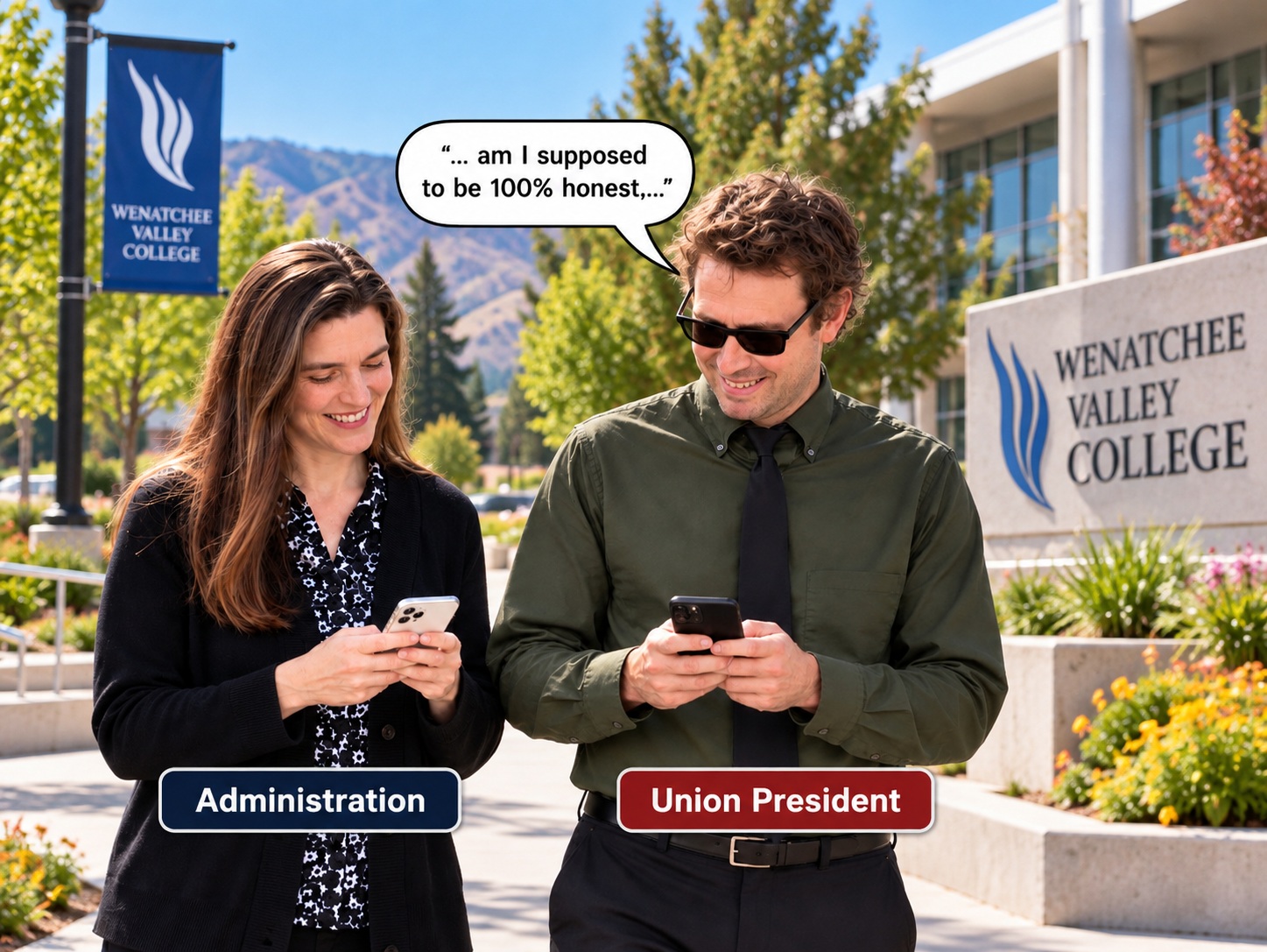
How honest should a faculty union president be with the agency responsible for accrediting his college? One hundred percent? Ninety percent? Or fifty percent, with the rest devoted to saying what might save his job?
That question surfaced in an April 22, 2026 text-message exchange involving Micky Jennings, president of the Association for Higher Education (AHE) at Wenatchee Valley College, as WVC faced ongoing scrutiny from the Northwest Commission on Colleges and Universities (NWCCU).
“100% Honest” or “50% Say What Needs to Be Said”?
Jennings asked Jennifer Hadersberger, WVC cabinet member and Interim Executive Director of Institutional Effectiveness:
See the original exchange for yourself: Read the text messages here.
“during these meetings, am I supposed to be 100% honest, 90% honest 10% optimistic, or 50% honest 50% say what needs to be said to save our jobs ... ?”
The response was equally revealing, although perhaps not in the way some readers might expect:
“Good question-yes honest. As you discuss strengths and weaknesses, plz also comment on whether or not you have seen any improvement work.”
Hadersberger also recalled their earlier work together as assessment coordinators. Importantly, her reply encouraged honesty. It did not direct Jennings to mislead accreditors.
But why was an elected faculty representative weighing honesty against saying what might protect "our" jobs? Was the question a joke, an attempt to balance criticism with optimism, or an expression of genuine concern about the consequences of candor?
A Cabinet-Level Administrator Advises Jennings
The April 22 texts show Jennings discussing the accreditation meetings with Jennifer Hadersberger, WVC’s Interim Executive Director of Institutional Effectiveness and a member of the college’s executive cabinet. The messages came from Hadersberger’s phone, according to Lisa Harger’s response concerning the public records production.
Hadersberger is not merely a college administrator. WVC’s own official President’s Cabinet directory lists her as Interim Executive Director of Institutional Effectiveness. The college describes its Cabinet as a senior advisory body that works directly with the president on strategic decisions, institutional priorities, policies, and operations. WVC also says Hadersberger supports continuous improvement through strategic planning and institutional data. That makes her leadership role especially relevant to accreditation discussions, although her advice in this exchange was explicitly to be honest.
Hadersberger’s actual reply urged Jennings to be honest and to describe any improvement efforts he had observed. The exchange does not establish any effort to mislead NWCCU. It does raise the question of how independently a faculty union president approaches an accreditation review while consulting a senior administrator.
Independence, Alignment, and a Faculty Award
WVC’s September 17, 2025 Board of Trustees minutes identify Jennings as AHE President and former grievance chair. The minutes say he worked with college leadership over the summer. During a cabinet update discussing reorganization and cost savings, Vice President Tod Treat expressed appreciation for Jennings’ “alignment and contributions.”
Collaboration is not misconduct. Faculty representatives often must work closely with administrators. But they must also be free to challenge them when faculty interests require it. Where does cooperation end and independence begin?
The college also publicly recognized Jennings with the Linda Schultz Herzong Outstanding Faculty of the Year Award at its end-of-year celebration.
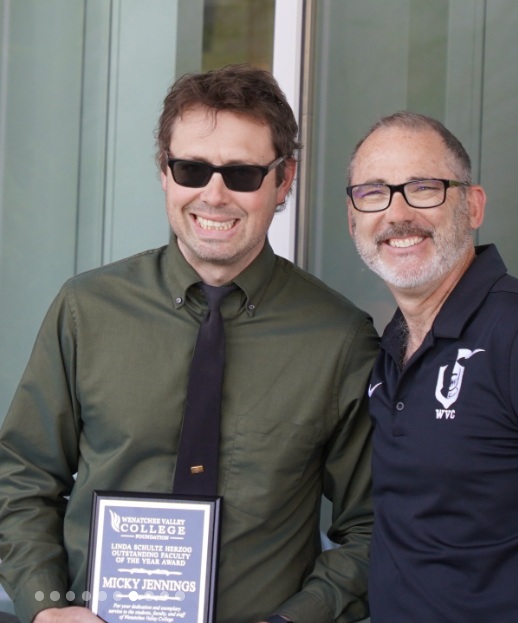
Jennings may well have earned the honor. The college’s announcement does not say who selected the recipient or whether administrators influenced the decision. Still, some readers may wonder whether an award presented by the institution to its faculty union president could create an appearance of favoritism, even if no favoritism occurred.
Jennings has also been associated with WVC’s machining program, while the college’s faculty directory lists him under Mathematics. That discrepancy may be routine, but it invites a straightforward explanation amid program and staffing changes. Neither the departmental listing nor the award establishes preferential treatment.
Faculty Concerns About a No-Confidence Vote and the Machining Program
A faculty source has told the WVC Blog that some instructors wanted a vote of no confidence in President Harrison and the Board of Trustees, but believed Jennings dismissed the proposal. The source also recalled Jennings attending a board meeting where faculty members spoke against renewing Harrison’s contract, without speaking publicly himself.
The source further expressed concern that the machining program had been considered for cuts and questioned whether Jennings’ cooperation with administration might have helped protect the program or his position. The source also described seeing Jennings frequently pictured alongside Harrison afterward.
These are faculty concerns, not established findings. The WVC Blog has not independently confirmed that the machining program was slated for elimination, that a formal no-confidence proposal was put to Jennings, or that any program decision was influenced by his relationship with administrators. Jennings’ silence at a particular meeting or appearance in photographs with Harrison would not, by itself, prove favoritism.
Nevertheless, the account raises a question worth examining: When the union president’s own program may be affected by budget decisions, how does the union ensure that faculty advocacy remains independent of the administration?
“Keep It Clean” and the Texting Question
Another exchange between Jennings and cabinet member Jennifer Hadersberger raises a pointed question about the college’s approach to written communications.
Jennings wrote:
“I have been told that texting admin is bad these days...”
Hadersberger responded:
“Go for it-just keep it clean”
Who told the faculty union president that texting administrators was “bad these days,” and why? The wording suggests Jennings had received advice or a warning about communicating with administration by text. It does not identify who gave that advice or what they meant.
Given WVC’s controversies involving missing and deleted text messages, including a senior official’s acknowledged practice of deleting texts at the end of the workday, the exchange raises a consequential possibility: Has WVC discouraged employees from putting public business in writing, rather than emphasizing how to document and preserve it properly?
If employees have been told to avoid texting administrators because those messages could be subject to public disclosure, that would raise serious transparency questions. But the exchange alone does not establish that WVC leadership issued such an instruction, or that “keep it clean” meant anything beyond communicating professionally.
Public business can generate public records regardless of the device or platform used. The appropriate response to public records concerns is clear guidance on retention and compliance, not avoiding a written record of government work. Readers can review the text exchange here.
A Beer Hat Amid Serious Business?
The communications also reportedly include Jennings suggesting he bring a beer hat to an important business meeting. Perhaps it was simply a joke. Without the full exchange, neither its intent nor its seriousness can be established. Readers can decide whether it is harmless humor or an odd note during a consequential period for the college.
Why Accreditation Makes These Questions Matter
NWCCU placed WVC on a public warning in August 2025. The college announced reaffirmation of its accreditation in August 2026, but the warning remained in effect, with further corrective work required. Board minutes also documented serious financial-audit delays.
Accreditors depend on reliable perspectives from administrators, faculty, students, and staff. Faculty representatives can describe problems that do not appear in an administration’s official presentation. Their independence is therefore important, particularly when an institution is working to resolve an accreditation warning.
No record presented here proves Jennings misled NWCCU, accepted a benefit in exchange for cooperation, or abandoned faculty interests. But his own question puts the central issue plainly before the community.
Readers: You Decide
“am I supposed to be 100% honest ... or 50% honest 50% say what needs to be said to save our jobs ... ?”
Was this an awkward joke, an attempt at constructive balance, or evidence of tension between faculty advocacy and administrative expectations?
At a college under accreditation warning, shouldn’t the answer to how honest anyone should be with reviewers simply be 100 percent?
Requests for Comment
The Wenatchee Valley College Blog will seek comment from Jennings, WVC administration, and NWCCU, and will update this article as responses or relevant records become available.
Sources and Context
April 22, 2026 text messages produced by WVC; September 17, 2025 Board of Trustees minutes; WVC employee-award announcement; college faculty and machining program listings; WVC’s official President’s Cabinet directory; NWCCU accreditation information.
Editorial note: Lisa Harger identified Jennifer Hadersberger as the source of the blue-side messages. Remarks about texting and the beer hat should be considered in the context of the full exchanges. The hero image is an editorial illustration, not a documentary photograph taken on WVC’s campus. The award photo comes from the supplied college celebration image. Faculty concerns about a possible no-confidence vote and proposed machining-program cuts are attributed to an unnamed faculty source and have not been independently verified. The article distinguishes documented facts, commentary, and unresolved questions.